


XRP-Volatilität sinkt vor Fed-Entscheid auf 1,54 Prozent
XRP recorded a narrow daily trading range of 1.54 percent ahead of the upcoming U.S. Federal Reserve interest rate decision, signaling an approaching market breakout as traders await macroeconomic clarity.

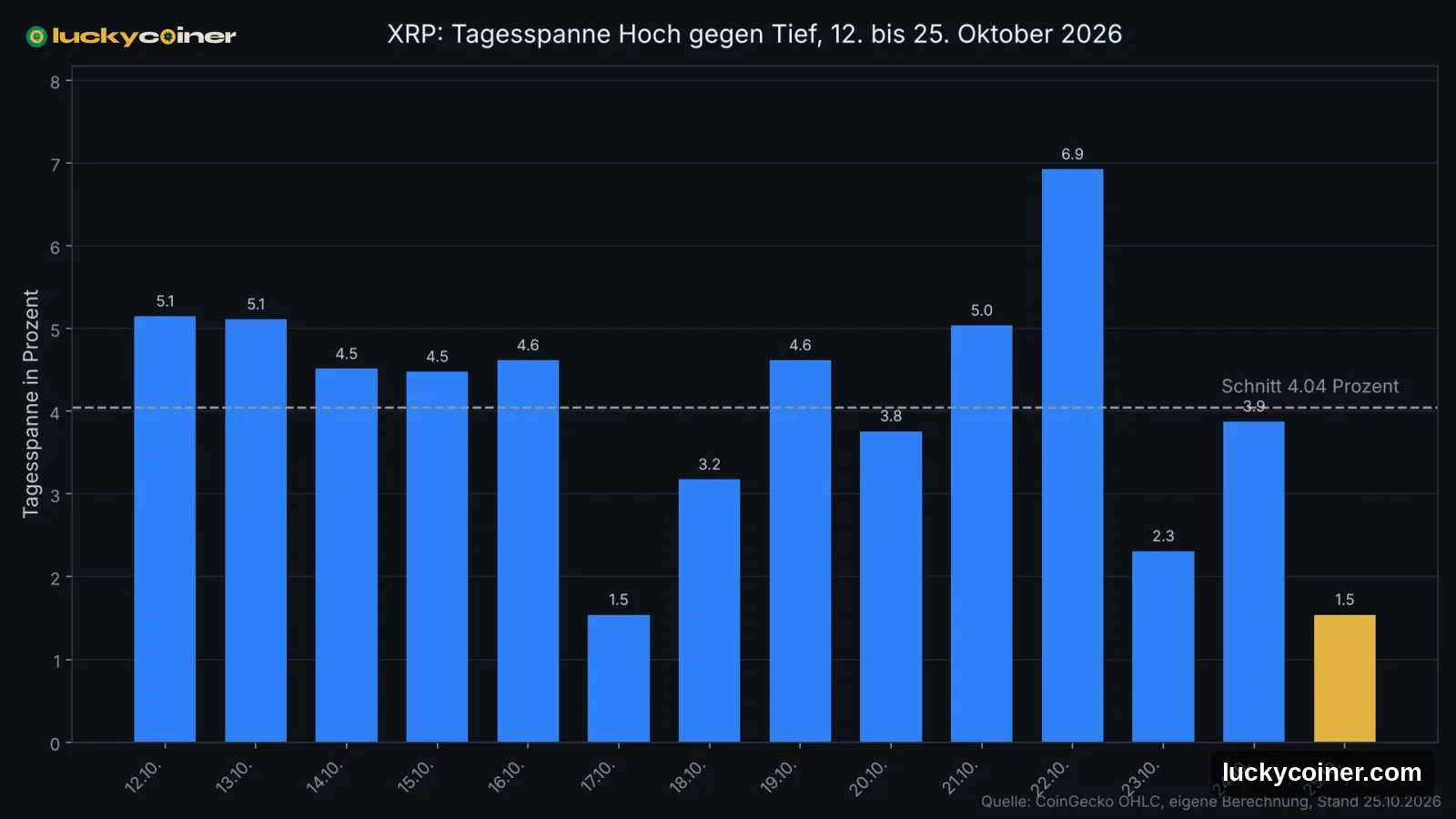
XRP stood at $1.30 on Sunday evening, recording a daily high of $1.31 and a daily low of $1.29. Based on the current price, this creates a daily trading range of 1.54 percent. Over the previous 14 trading days, this range averaged 4.04 percent. Such a narrow band does not indicate direction; instead, it signals the approaching moment when a breakout will occur.
The token’s price barely shifted on Sunday, gaining 0.65 percent over a 24-hour period according to CoinGecko market data retrieved on the evening of October 25. The key takeaway is not this slight increase, but the minimal distance required to achieve it, with a mere two cents separating the peak from the trough.
How Narrow This Trading Session Actually Was
The daily range is calculated as the gap between a day’s peak and lowest price, divided by the current price. This metric reveals the distance buyers and sellers covered during the session, regardless of the closing price. A day can close up 0.1 percent while still posting a six-percent range if the price initially fell before recovering.

For October 25, this calculation yields 1.54 percent. Based on an independent review of CoinGecko OHLC data for the past 14 days, only one other day in October matched this tightness: October 17, which also recorded 1.54 percent. The widest session occurred on October 22 at 6.92 percent—four and a half times the distance.
Positioned between these extremes is the 14-day average of 4.04 percent, leaving today’s figure 62 percent below the fortnight’s mean. Looking solely at closing prices masks this activity: October 23 ended at $1.308, and October 25 closed at $1.299, a difference of less than one percent despite entirely different intraday paths.
What a Shrinking Range Reveals About the Market
A compressed range forms when buyers and sellers agree on valuation, and neither side is willing to trade significantly above or below that level. This typically happens for two reasons: falling trading volume due to fewer active participants over the weekend, or market participants waiting for upcoming information.
Both factors apply to this Sunday, with the latter carrying greater weight. The U.S. Federal Reserve is scheduled to announce its interest rate decision on Wednesday, October 28. Establishing a large position now means carrying that risk through the announcement, prompting many to step aside and wait, which in turn compresses the chart.
This dynamic extends across the broader market, which remained remarkably still on Sunday: Bitcoin dropped 0.02 percent, Ethereum rose 0.19 percent, Solana declined 0.27 percent, and Dogecoin fell 0.11 percent. XRP led these five major assets with a 0.65 percent gain, though this remains little more than market noise. Periods of collective stagnation among major assets typically precede major decisions rather than representing decisions themselves.
The Wednesday Rate Decision and Its Path to the Price
The Federal Open Market Committee meets on October 27 and 28, with the policy decision scheduled for Wednesday at 2:00 p.m. Washington time (7:00 p.m. in Germany), as listed in the official Federal Reserve calendar. A press conference follows 30 minutes later, and market reactions to official commentary often outweigh the rate adjustment itself.
Interest rate decisions influence crypto prices through two main channels. First, the dollar: higher rates make dollar-denominated assets more attractive, strengthening the currency and creating headwinds for dollar-priced assets. Second, institutional risk appetite: lower rates make non-yielding assets easier to justify, benefiting the cryptocurrency sector.
XRP features a third distinct factor: heavy reliance on derivatives trading. On October 24, open leverage accounted for 4.8 percent of market capitalization. These leveraged positions carry expiration dates and ongoing funding rates, meaning participants cannot indefinitely ignore a stagnant market.
What Has Changed Since the October 24 Measurement
On October 24, XRP closed at $1.2938. The price currently sits at $1.2986, marking a 0.37 percent increase over two days. The leverage load of 4.8 percent of market capitalization recorded then was the lowest seen all month, and prices have remained virtually unchanged since. Today’s tight range is therefore a continuation of a two-day trend.
The distance to the monthly low has shifted. On October 18, XRP hit a monthly closing low of $1.2927, and the price currently rests 0.46 percent above that mark. This gap stood at 5.6 percent on October 22 following a rally to $1.3651, meaning this week’s recovery has been fully erased without a single day of severe losses.
Key Levels Where the Range Will Break
Data from the past two weeks highlights three distinct technical levels:
To the downside, the first level is $1.2927, representing the October 18 close and the monthly low. A break below this level points to $1.26, the lowest intraday point reached on October 18 and 19. A 2.5 percent gap separates these two figures, a zone where the market rebounded twice in October.
To the upside, the initial hurdle is today’s high of $1.31. Above that lies $1.3651, the October 22 close and last week’s intermediate peak. The third level is $1.40, the October 21 daily high and the most recent price where XRP traded more than four percent above current levels.
Looking at the month as a whole, XRP opened October 1 at $1.4896 and sits at $1.2986, a 12.8 percent decline over 25 days. The token trades 14.6 percent below its October 5 monthly high of $1.5197 and 64.4 percent below its all-time high of $3.65, with a market capitalization of $82.3 billion.
Why Leveraged Positions Are More Dangerous in Tight Ranges
Because this mechanism is frequently misunderstood, it can be broken down simply: Leveraged traders post only a fraction of their position’s value as collateral and face automatic liquidation if price movements erode that margin. In quiet markets, traders often place stop-losses closer to the current price because volatility appears low. When the range finally breaks, these concentrated orders trigger simultaneously, and resulting forced liquidations amplify the initial price swing.
For investors, current market calm is a warning against increasing leverage. Anyone holding leveraged positions ahead of Wednesday should identify their exact liquidation price relative to the $1.26 threshold. Fees and funding rates vary widely across exchanges, as shown in perpetual exchange comparisons.

Two November Dates Already on the Calendar
Following Wednesday, two upcoming dates will directly impact XRP independently of general market trends.
On November 1, Ripple’s scheduled monthly escrow release takes place. Tokens are contractually locked and released in tranches of one billion XRP, though Ripple typically relocks the vast majority, meaning the actual circulating supply increase is much smaller than headlines suggest. The key variable is how many tokens return to escrow.
The second date is November 4, the deadline for validator approval of an XRP Ledger protocol modification that missed its initial October 23 target.
Both events occur within a ten-day window. Combined with Wednesday’s rate decision, three catalysts follow in rapid succession, any of which could break the current 1.54 percent trading range.
Market Assessment
The narrow trading range is the weekend’s primary signal and cannot be interpreted as a directional indicator. Supporting this view is the simultaneous stagnation of Bitcoin, Ethereum, Solana, XRP, and Dogecoin, all posting sub-one-percent moves, which points to Wednesday’s macroeconomic event rather than project-specific factors. Conversely, price compression indicates the probability of a breakout rather than its direction. The tight range is a fact; its outcome is not.
Consequently, the October 18 low of $1.2927 serves as the benchmark for whether October ends with a new monthly low. The price sits less than half a percent above this level. To the upside, XRP requires a 5.1 percent gain to reclaim the October 22 intermediate high. The asymmetry between these distances highlights current market conditions without offering a directional recommendation.
Actionable Steps for Investors
Three considerations can be evaluated independently of the Federal Reserve, and all are easier to manage during a quiet weekend than on Wednesday evening:
First, holding periods. Holding XRP in self-custody for over a year qualifies capital gains for tax exemptions under current rules. With prices sitting 64 percent below all-time highs, verifying whether positions have crossed the one-year mark is essential.
Second, custody. XRP held on an exchange legally belongs to the platform until withdrawn. Ahead of potential volatility that could trigger forced liquidations, distinguishing between personal self-custody and exchange accounts is critical.
Third, transaction fees. With prices around $1.30 and positions worth a few hundred euros, exchange spreads often impact returns more than weekly price action.
XRP Ahead of the Fed: Direction Emerges Below $1.2927
The current setup in three steps:
- Note the key levels. $1.2927 to the downside and $1.3651 to the upside define the range where XRP has traded since October 23.
- Review leverage exposure. Leveraged traders should document their exact liquidation price before Wednesday at 7:00 p.m.
- Organize purchase records. The 12-month holding period is calculated from the exact acquisition date, requiring accurate portfolio tracking and tax tools.
(As of October 25, 2026. This article does not constitute investment advice. Prices and fee structures change; verify terms directly with providers before trading. Cryptocurrency investments carry the risk of total capital loss.)
FAQs
5 questions01Why is the daily trading range for XRP so narrow?
The daily range has compressed to 1.54 percent because market participants are largely waiting on the sidelines ahead of the U.S. Federal Reserve’s interest rate decision on Wednesday, October 28.
02What price levels should traders watch when the range breaks?
Key downside levels include $1.2927 (the October 18 monthly low) and $1.26. Key upside levels include today’s high of $1.31, followed by $1.3651 and $1.40.
03How do interest rate decisions affect XRP and other cryptocurrencies?
Rate decisions impact cryptocurrencies through two channels: currency strength (as higher rates boost the U.S. dollar, creating headwinds for dollar-priced assets) and institutional risk appetite (as lower rates make non-yielding assets like crypto more attractive).
04Why are leveraged positions particularly risky during low-volatility periods?
In narrow ranges, traders often place stop-losses very close to current prices. When the market finally breaks out, these concentrated orders trigger simultaneously, causing cascading liquidations that amplify the price movement.
05What upcoming events could break the current market stagnation?
Aside from the Fed’s rate decision, upcoming catalysts include Ripple’s monthly escrow release on November 1 and the November 4 deadline for validator approval of an XRP Ledger protocol modification.

